

For most of human history, if you needed rope, you grew it.
Hemp built the Royal Navy. A single ship of the line carried tens of miles of hemp cordage, and British naval dominance depended on a supply chain of hemp fields, rope walks and tar. The word canvas comes from cannabis. This was not a niche crop. It was strategic infrastructure.
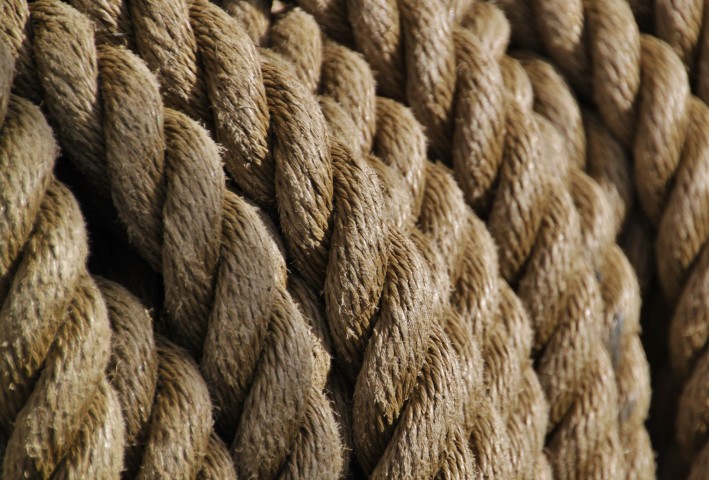
Then, within roughly a generation, it vanished. Nylon arrived in 1935, polypropylene followed after the war, and by the 1960s natural fibre rope had been comprehensively displaced almost everywhere it had ever been used. Synthetics were stronger by weight, did not rot, did not need tarring, and cost less. The argument was over before it started.
Except it was not quite over.
What synthetic rope quietly lost
Anyone who has handled both knows the difference immediately, even if they cannot articulate it.
Synthetic rope is slick. It has memory, meaning it wants to return to the shape it was coiled in. It holds knots less willingly, and under load it can slip in ways natural fibre does not. It generates friction heat. And it feels, unmistakably, like plastic, because it is.
Natural fibre grips. Hemp and jute have a surface texture that holds a knot the moment it is set. They soften with handling and develop a patina specific to their use. They have a smell. They behave in a way that people who work with rope describe as communicative, which sounds like mysticism until you have used both and understood that the material genuinely tells you more about what it is doing.
None of that mattered to a shipping company. It matters enormously to anyone whose relationship with the material is tactile rather than purely functional.
Who brought it back
The revival came from the crafts first. Macramé returned in the 2010s and brought jute and cotton cord with it. Gardeners went back to hemp twine because it composts and because plastic ties strangle stems. Traditional boatbuilders and heritage restoration projects never left, because authenticity was the entire point.
Then there is the community that has done more than any other to keep hemp rope commercially alive in the West, and which almost never gets credited for it: the Japanese rope arts.
Shibari and its derivatives are built specifically around jute and hemp. The technical reasons are the ones above, and they are not aesthetic preferences. Natural fibre holds a knot without a locking hitch. It does not slip under load. It does not generate friction burn the way synthetic does. Practitioners buy raw jute, condition it themselves, break it in over months, and treat it as a material with a lifespan. They oil it, store it properly and retire it when it goes. That is craft knowledge, indistinguishable in kind from how a woodworker treats a plane iron.
The economics are worth noticing. Small European hemp rope producers exist today in meaningful part because that community sustained demand through the decades when nobody else wanted the stuff. UK retailers stocking rope and related equipment, such as mydungeon.co.uk, sit inside a supply chain that traces directly back to growers and rope walks that would otherwise have closed. An industry preserved by the people who cared how it felt in the hand.
Growing it in Britain again
Industrial hemp is legal to grow in the UK under licence. It is not a grey area, and it is not difficult in principle: applications go through the Home Office, the crop must be an approved low-THC variety, and the gov.uk guidance on industrial hemp licensing sets out the process.
In practice the licensing regime, the restriction to seed and fibre, and limited domestic processing capacity have kept British acreage far below where the agronomy suggests it should be. Hemp is close to an ideal rotation crop for these islands. It suppresses weeds so thoroughly it needs almost no herbicide, it needs little irrigation in a British climate, its roots break up compacted soil, and it sequesters carbon at a rate that makes most alternatives look poor.
There is a slow shift happening. Hempcrete has found a genuine foothold in low-carbon construction. Hemp textiles are creeping back into clothing. Several UK growers have built viable businesses on fibre and seed
The pattern underneath
The interesting thing about natural fibre’s return is that it is not nostalgia and it is not really environmentalism, although both feature in the marketing.
It is people rejecting the idea that measurable performance is the only thing worth optimising for. Synthetic rope wins on tensile strength per gram and cost per metre, and if those are your only metrics the argument really is finished. But they are not the only metrics that matter to a person actually holding the thing. Grip, feel, smell, how it ages, whether it will still be usable in ten years, whether it goes back into the ground when it is finished.
Wooden furniture over flat-pack. Cast iron over non-stick. Cotton over polyester. Hemp over nylon. The same argument, made repeatedly, by people who have worked out that the cheapest thing that technically does the job is not automatically the best thing.
The Navy had its reasons for switching. Most of us are not fitting out a ship.
Leave a Reply