
There’s a world growing on that crumbling churchyard wall you walk past every Sunday, and I’d bet good money you’ve never once stopped to look at it. We’re talking about lichen, moss, and fungi. Tiny, ancient, devastatingly slow. Organisms that have been quietly colonising Britain’s stone surfaces for thousands of years whilst the rest of us got on with being loud about it.
Lichen biodiversity in the UK is genuinely one of the more underappreciated stories in ecology. Not the kind of thing that makes the front page of the BBC, but very much the kind of thing that tells you everything about whether the land you’re standing on is healthy or not. These organisms are bioindicators, meaning they respond to the quality of air and soil around them with a sensitivity that no instrument comes close to matching. If the lichen is thriving, things are probably alright. If it’s gone, something’s off.
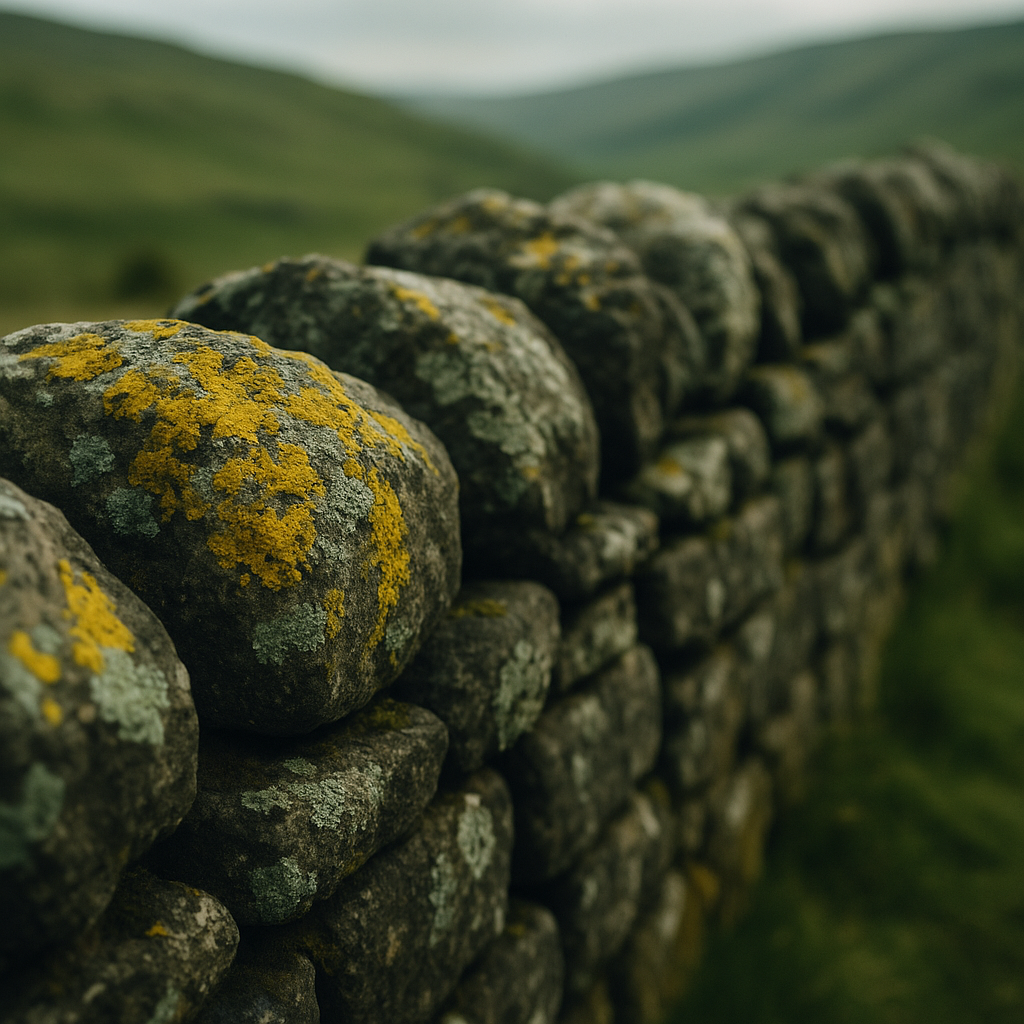
What actually is lichen, and why does it live on walls?
Lichen isn’t just one thing. It’s a partnership, a fungi and an alga (or sometimes a cyanobacterium) living together in a relationship that’s about 400 million years old. The fungi provides structure and protection. The alga does the photosynthesis and feeds them both. It’s one of nature’s neater arrangements, and it means lichen can live in places where nothing else would bother trying.
Dry stone walls are perfect for them. No soil needed. No regular rainfall required. The rough texture of limestone, sandstone or old brick gives them something to anchor onto, and the slow thermal mass of stone means temperature swings are gentler than on bare ground. Churchyard slabs are especially good because they’re old, undisturbed, and often sheltered. You’ll find some of Britain’s rarest lichen species on nothing more exciting than a flat grave marker in a quiet Cotswolds village.
In urban settings it gets interesting too. Brickwork in older parts of cities like York, Bristol or Edinburgh carries remarkable surface biodiversity when air quality is good enough. The relationship between lichen and clean air is well-documented. Sulphur dioxide pollution, which was catastrophic during the industrial period, wiped out enormous numbers of lichen species across Britain’s towns and cities. The fact that certain species are now creeping back into urban areas is a genuine marker of improving air quality, and something the UK Centre for Ecology and Hydrology has tracked for decades.
Moss: the underdog doing heavy lifting in small spaces
Moss is different to lichen but often found in the same spots. Where lichen tends to hug flat surfaces tightly, moss builds up in cushions and mats, particularly in joints between stones where a little moisture and debris accumulates. That stuff is doing actual ecological work. A single centimetre of moss can hold several times its own weight in water, which means a mossy wall is quietly managing local moisture, buffering against dry spells, and providing microhabitat for invertebrates.
The variety is remarkable once you start looking. Tortula muralis, wall screw-moss, is everywhere in Britain and grows in tight little rosettes that turn a vivid green after rain. Grimmia pulvinata, the grey-cushioned grimmia, looks almost silvery when dry and sits in pincushion clumps on top of old walls. Neither of these names will win you a pub quiz, but they’re as British as anything else growing in this country and they deserve a bit of credit.
Fungi on stone: the ones you probably haven’t noticed
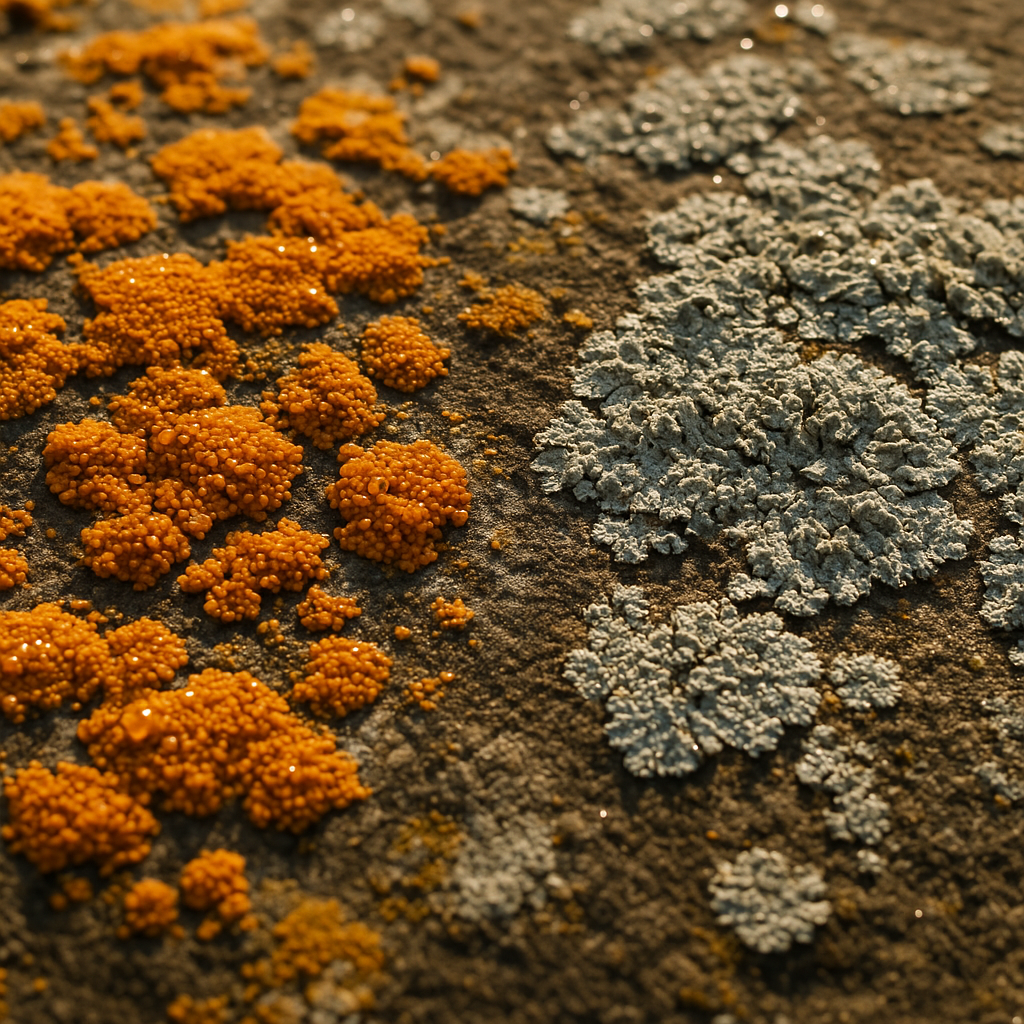
Fungi tend to get all the attention when they’re producing fruiting bodies, those big dramatic mushrooms in autumn woodland. But the fungi working away on stone surfaces are mostly invisible, growing as thin threads through the rock itself, slowly breaking it down. This process, called bioweathering, is genuinely useful. It helps release minerals, creates microsites for other organisms, and over geological time contributes to soil formation.
Some lichen-forming fungi are visually striking once you know what you’re looking at. Map lichen (Rhizocarpon geographicum) makes bright yellow-green patches on siliceous rocks and has been used by scientists to date geological events because it grows at such a predictable rate. A patch 10 centimetres across on an exposed mountain boulder in Snowdonia might be 200 years old. That kind of slow, quiet persistence is hard not to respect.
Why lichen biodiversity tells you something about your local environment
This is the bit that makes lichen genuinely worth paying attention to from a wellness and environmental standpoint. Air quality, nitrogen levels, soil disturbance, chemical use nearby, and even noise pollution can all affect what grows on a given wall. Sensitive species like the lungwort lichen (Lobaria pulmonaria) only survive in areas with very clean, humid air, which is why it’s found clinging to ancient trees and mossy walls in the western Scottish Highlands and barely anywhere else.
If you want to get a rough sense of your local air quality, a ten-minute walk looking at what’s growing on old stone is a reasonable proxy. Crustose lichens (the ones that look painted directly onto the surface) are the most tolerant. Foliose lichens (leafy, with lobes) are mid-range. Fruticose lichens (shrubby, branching, hanging off surfaces) are the most sensitive and the first to disappear when things deteriorate. The more fruticose species you see, the cleaner the air generally is.
This connects to a broader point about how much ecological information is just sitting there in the landscape if you slow down enough to read it. It’s the same principle behind spending time in hedgerows spotting medicinal wild plants, or paying attention to what Britain’s soil is actually doing beneath our feet. The signals are there. We just walk past them.
Finding lichen hotspots near you
Old churchyards are the single best place to start in the UK. They’ve often been undisturbed for centuries, the stone is varied, and because they haven’t been treated with herbicides or fertilisers, the surfaces are clean. The British Lichen Society keeps a database of notable sites if you want to go deeper. National parks, particularly in Wales, the Lake District and the Scottish Highlands, have exceptional populations on old dry stone walls and rocky outcrops.
Urban hunting is genuinely fun too. Look for old brick walls, stone gate pillars, and the kerbing along older streets. Victorian-era stonework is often species-rich. Just slow down, get your face close to the wall, and actually look. It helps to go after rain when colours are more vivid.
How to help rather than harm
The main threats to wall-dwelling organisms in Britain are pressure washing, chemical cleaning agents, and the removal of old walls in favour of fencing or block paving. A lot of this happens in gardens and on private property where people simply don’t know what they’re scrubbing off. Algae-and-moss killers sold at every garden centre will obliterate decades of lichen colonisation in one afternoon.
If you have an old stone wall in your garden, the best thing you can do is leave it alone. Don’t pressure wash it. Don’t apply biocides. If it’s structurally sound, let it grow. The organisms on it are part of a living system, connected to the same impulse that makes people obsessive about composting or protecting pollinators. They’re the overlooked end of the biodiversity conversation, and they deserve a place in it.
There’s also something quietly profound about the timescales involved. The patch of map lichen on that old Lancashire dry stone wall might have started growing when your great-great-grandparents were children. Shared infrastructure like rooftop antenna installations or Communal Aerial Systems mounted to old stone buildings sometimes involves structural work that can disturb surfaces like these, so it’s worth flagging to contractors when old walls are involved. It’s a small thing, but lichen won’t be back quickly if it goes.
Britain’s stone surfaces are a slow, living archive. We’d do well to treat them that way. And if you want another reason to slow down and pay attention to the landscape around you, read about what Britain’s shifting seasons are doing to our mental health. The two are more connected than they might seem.