

Right, so everyone and their nan is suddenly talking about adaptogens. You’ve probably seen the word on the side of a mushroom latte at your local health food shop, or spotted it on a wellness influencer’s shelf next to the crystal collection. But here’s the thing: adaptogens aren’t new. They’ve been used in Ayurvedic and Traditional Chinese medicine for literally thousands of years. The whole “best adaptogens for stress relief” conversation has just finally made its way from ancient herbalism into the modern wellness mainstream, and honestly, it makes sense given how many of us are absolutely cooked by daily stress.
Let’s have a proper look at what these plants actually do, which ones are worth your time, and how to bring them into your life without it feeling like a second job.
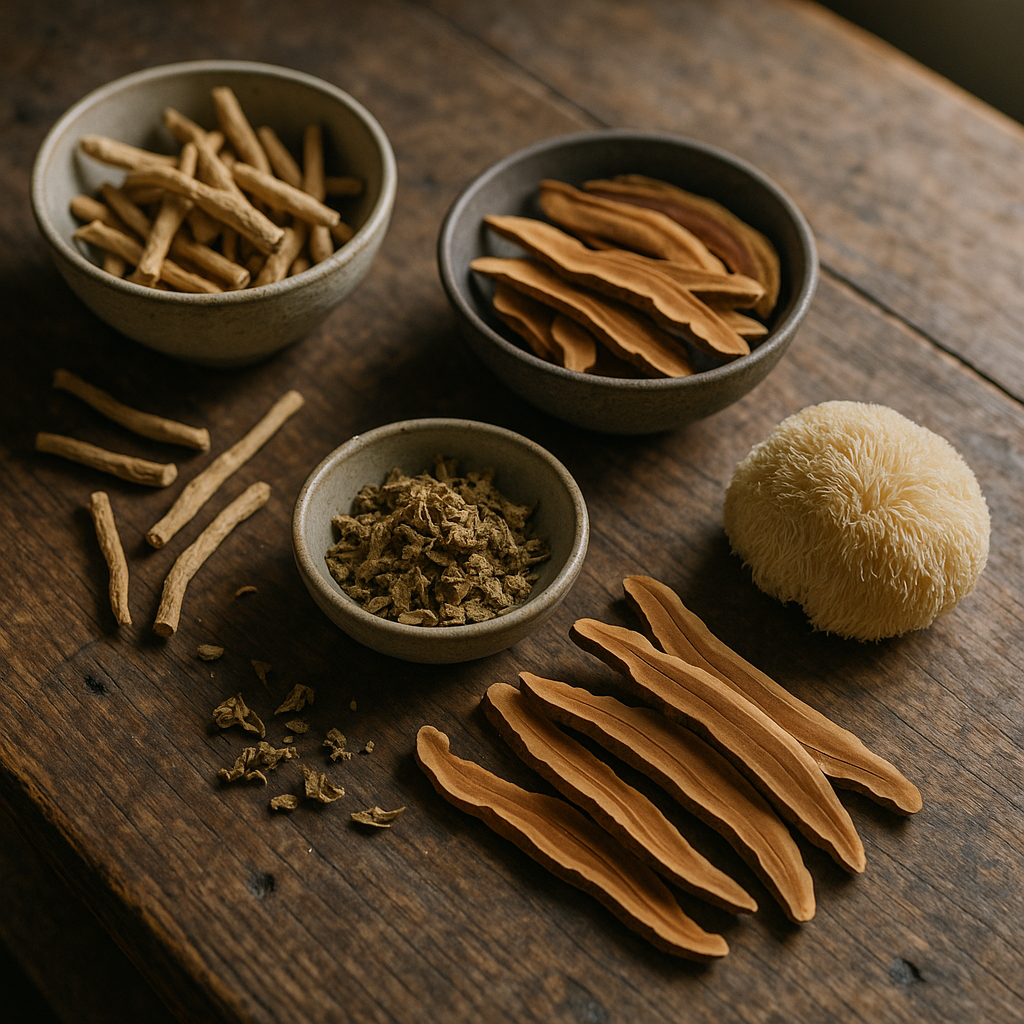
So What Actually Is an Adaptogen?
An adaptogen is a herb or mushroom that helps your body adapt to stress. Not in a vague, hand-wavy wellness sense, there’s a more specific definition. To qualify as an adaptogen, a substance needs to be non-toxic at normal doses, help normalise bodily functions under stress, and have a broad, non-specific action on the body rather than targeting one specific thing. Think of them less like medicine and more like a gentle recalibration for your nervous system.
The idea is that they work on the hypothalamic-pituitary-adrenal (HPA) axis, the system that controls your stress response and cortisol output. Chronic stress hammers this system. Adaptogens essentially help buffer the impact, bringing you back towards balance rather than pushing your body in one direction or another.
That said, they’re not a silver bullet. They work best as part of a broader lifestyle that includes decent sleep, time in nature, and not eating pure rubbish. But as additions to a decent foundation? Some of them are genuinely impressive.
Ashwagandha: The One Everyone Starts With
Ashwagandha (Withania somnifera) is probably the best-known adaptogen in the UK right now, and for good reason. It’s been studied more rigorously than most herbal supplements, and the research is fairly encouraging. A 2019 study published in Medicine found that participants taking ashwagandha root extract showed significant reductions in stress, anxiety, and cortisol levels compared to a placebo group.
Practically speaking, most people taking ashwagandha report that it takes a couple of weeks to notice anything, this isn’t a quick fix. But after a fortnight or so, the common experience is feeling slightly less wired, sleeping better, and recovering from stressful days a bit quicker. I’ve found it works well taken in the evening with a warm drink.
It comes in capsules, powders, and tinctures. The powder has a distinctive earthy, slightly bitter taste that can be an acquired thing, start with capsules if you’re not keen on experimenting with flavour. Look for a root extract standardised to withanolides if you want the stuff that’s actually been tested.
Reishi: The Chill Mushroom
Reishi (Ganoderma lucidum) has a reputation as the “mushroom of immortality” in Chinese medicine, which is obviously a big claim. Strip away the mythology and you’ve still got something genuinely interesting. Reishi contains bioactive compounds called triterpenes and beta-glucans that appear to have immune-modulating and stress-calming effects.
It’s not stimulating like coffee. Reishi is more of a slow, mellow kind of support, often described as promoting a sense of calm without sedation. Some people find it helps with sleep quality, which makes sense given that poor sleep and chronic stress are deeply intertwined. If you’re somebody who lies awake with your brain spinning, reishi is worth exploring.
In terms of format, reishi is most commonly found as a powder extract or in capsule form. A proper dual-extract (both water and alcohol extracted) is what you want to get the full range of compounds. The taste is quite bitter on its own, so most people blend it into hot drinks or smoothies.

Lion’s Mane: The Brain One
Lion’s mane (Hericium erinaceus) is a bit different from the others in this list because its primary reputation is around cognitive support rather than pure stress relief. But stress and brain fog are so tangled together that it earns its place here. Lion’s mane contains compounds called hericenones and erinacines that appear to stimulate the production of nerve growth factor (NGF), which supports the health and regeneration of neurons.
Anecdotally, people report improved focus, clearer thinking, and better mood after consistent use. A small Japanese study found that women who consumed lion’s mane over four weeks reported reduced feelings of irritability and anxiety. The research base is still growing, but the direction is promising.
If your stress manifests as brain fog, forgetfulness, or that feeling of being overwhelmed by ordinary tasks, lion’s mane might be more immediately useful than ashwagandha. Again, dual-extract powders are the most bioavailable format, add to your morning coffee or oat milk latte and you’re sorted.
A Few Others Worth Knowing About
The best adaptogens for stress relief extend beyond the headline three. Rhodiola rosea is a solid one for people who feel chronically fatigued rather than purely anxious, it has a mild stimulating quality that makes it better taken in the morning. Holy basil (tulsi) is gentler and works nicely as a tea, making it easy to incorporate without any pills or powders. Siberian ginseng (eleuthero) is used a lot in endurance sports for sustained energy and stress resilience.
The NHS doesn’t currently endorse any specific herbal supplements for stress management, so if you’re on prescribed medication, particularly antidepressants or thyroid medication, check with your GP before adding adaptogens into your routine. Some, including ashwagandha, can interact with certain medications. The NHS has useful guidance on stress management that’s worth reading alongside any herbal approach.
How to Actually Add Them to Your Day
The biggest barrier for most people isn’t knowing which adaptogens to take, it’s building the habit. Here’s what I’d suggest: start with one, not three. Give it a month before deciding whether it’s doing anything. Adding too many things at once means you’ll never know what’s working.
Morning routine: lion’s mane or rhodiola blended into your coffee or a mushroom hot chocolate. These tend to be more energising and suit the start of the day.
Evening wind-down: ashwagandha or reishi in warm oat milk with a bit of cinnamon. It sounds fancier than it is, and genuinely helps signal to your body that it’s time to slow down.
Keep your expectations realistic. Adaptogens are supportive, not transformative overnight. The people who get the most out of them are usually those who are already doing the basic stuff right, decent sleep, regular movement, spending time outdoors, eating actual food. Think of adaptogens as the finishing touch, not the foundation.
Finding Quality Products in the UK
The UK supplement market is largely self-regulated, which means quality varies enormously. Look for brands that provide third-party lab testing, specify the extract ratio or standardisation on the label, and are transparent about where their ingredients are sourced. Avoid anything where the active compound content is vague or unspecified, that’s usually a sign the product is underdosed.
A few UK-based and UK-available brands worth researching include Mushrooms 4 Life, Planet Paleo, and Naturya, though as always, do your own reading and compare before buying. Holland and Barrett stock some decent options if you want to start simply without ordering online.
The main thing is to be a bit patient with it. Adaptogens are slow medicine. But when they work, they genuinely do feel like something shifted, not dramatically, just a bit more steady. A bit more you. Which, after a long stretch of feeling scattered and stressed, is honestly enough.
Frequently Asked Questions
What are the best adaptogens for stress relief for beginners?
Ashwagandha is the most researched and widely available starting point, with consistent evidence supporting its effect on cortisol and anxiety levels. If you’d prefer something gentler, holy basil (tulsi) taken as a tea is a low-commitment way to begin. Give whichever you choose at least three to four weeks before judging whether it’s working.
How long does it take for adaptogens to work?
Most adaptogens aren’t fast-acting, expect a minimum of two to four weeks of consistent daily use before noticing a meaningful difference. Some people report subtle changes in sleep quality or mood fairly quickly, but the deeper stress-buffering effects typically build gradually over time.
Can you take multiple adaptogens together?
Yes, many people stack adaptogens, and some supplement brands sell blended formulas. However, starting with one at a time is sensible so you can actually tell what’s helping. If you do combine them, it’s worth keeping dosages within the recommended ranges for each individual herb.
Are adaptogens safe to take every day?
Most well-studied adaptogens like ashwagandha, lion’s mane, and reishi are considered safe for daily use at recommended doses for healthy adults. That said, if you’re pregnant, breastfeeding, or taking prescribed medication, it’s important to speak to your GP first, as interactions are possible with some herbs.
Where can I buy good quality adaptogens in the UK?
Holland and Barrett, independent health food shops, and reputable online retailers are all reasonable options. The key is to look for products that specify extract ratios or standardised active compounds on the label, and ideally have third-party lab testing. Brands like Mushrooms 4 Life and Planet Paleo are UK-available options with decent transparency around their sourcing.
Leave a Reply